Amex Gold vs. Business Gold 2026: Which Card Should You Get?
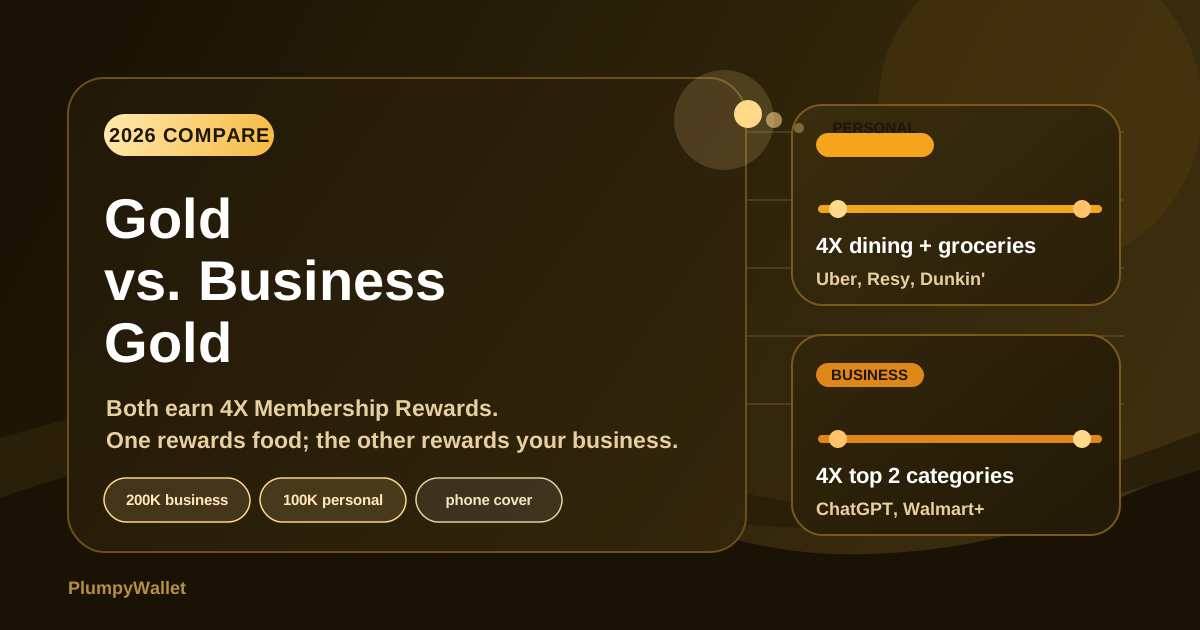
Quick Summary: American Express sells two "Gold" cards that look like siblings but serve different masters. The personal American Express Gold Card is built for food lovers, while the American Express Business Gold Card is built for business owners with concentrated spending. Both earn 4X points and carry a similar annual fee, but the earning structure and credits are completely different.
- Annual Fee: $325 (personal Gold) vs. $375 (Business Gold)
- Welcome Offer: Personal up to 100,000 points ($4,000 in 6 months); Business up to 200,000 points ($15,000 in 3 months)
- Earning Difference: Personal earns 4X on fixed categories (dining + U.S. supermarkets); Business earns 4X on your top 2 of 6 business categories each month
- Credit Difference: Personal leans lifestyle (Uber, dining, Resy, Dunkin', hotel); Business leans operations (ChatGPT, FedEx, Walmart+, Squarespace)
- Best For: Personal for households that dine out and grocery shop; Business for companies with recurring spend in a few categories
American Express markets both a consumer Gold Card and a Business Gold Card, and because they share the same name, color, and points currency, it is easy to assume they are two versions of the same product. They are not. One is a dining-and-groceries card for individuals; the other is a flexible business-rewards card for owners.
If you only carry one card, the right choice comes down to where your money actually goes. If you are a business owner, you may even qualify for both, and the two can complement each other. This guide compares them side by side so you can decide with confidence.
At a Glance: The Head-to-Head
| Feature | Amex Gold (Personal) | Amex Business Gold |
|---|---|---|
| Annual fee | $325 | $375 |
| Welcome offer | Up to 100,000 points after $4,000 in 6 months | Up to 200,000 points after $15,000 in 3 months |
| 4X earning | Fixed: restaurants worldwide (up to $50K/yr) + U.S. supermarkets (up to $25K/yr) | Flexible: top 2 of 6 categories each billing cycle (up to $150K/yr combined) |
| 3X earning | Flights booked directly with airlines or Amex Travel | Flights and prepaid hotels booked on Amex Travel |
| 5X earning | Prepaid hotels booked on Amex Travel | None |
| Statement credits | ~$524/yr: Uber, dining, Resy, hotel, Dunkin' | ~$845/yr: ChatGPT Business, FedEx/Grubhub/office supply, Walmart+, Squarespace |
| Cellphone protection | No | Yes, up to $800 per claim |
| No preset spending limit | Yes | Yes |
| Foreign transaction fees | None | None |
| Who can apply | Any consumer | Requires a business (including sole proprietor) |
Welcome Offers: Business Wins on Size
The Business Gold's welcome offer is significantly larger. As of 2026, it can be as high as 200,000 Membership Rewards points after you spend $15,000 in the first three months. The personal Gold offers up to 100,000 points after $4,000 in spend within six months.
Two things matter here. First, the business bonus is worth roughly twice as much in points value. Second, the business card demands both a higher spend and a tighter window. If your business naturally has large early purchases, the higher threshold is easy. If you are an individual who cannot push $15,000 through in three months, the personal card's lower bar and longer window is friendlier.
One important detail: American Express frequently varies these offers by applicant, so the exact number you see at application can differ from the headline figures above.
Earning Rates: Fixed vs. Flexible 4X
Both cards earn 4X on select categories, but the way they pick those categories could not be more different. That is the heart of the comparison.
The Personal Gold Earns 4X on Food
The personal Gold earns 4X Membership Rewards points at restaurants worldwide (up to $50,000 per year) and at U.S. supermarkets (up to $25,000 per year), then 1X after the caps. It also earns 5X on prepaid hotels booked through Amex Travel and 3X on flights booked directly with airlines or through Amex Travel. This structure rewards how a household eats and shops, and it needs zero management: the bonus categories are fixed.
The Business Gold Earns 4X on Your Top Two Categories
The Business Gold does not give you fixed categories. Instead, it automatically awards 4X on your top two eligible categories each billing cycle, up to $150,000 in combined purchases per calendar year, then 1X. The eligible categories are:
- U.S. purchases at restaurants (including takeout and delivery)
- U.S. purchases at gas stations
- U.S. purchases for advertising in select online, TV, and radio media
- Transit purchases
- U.S. electronics and software/cloud providers
- Monthly wireless telephone service charges from U.S. wireless providers
This means the card does the sorting for you. If your business spends most on software and advertising one month, those two earn 4X. If next month it is gas and restaurants, those two earn 4X. For a business with shifting but concentrated spend, that flexibility is the card's biggest advantage.
The practical read: the personal card rewards how you live, while the business card rewards how your business buys.
Credits: Lifestyle vs. Operations
Both cards offset their annual fee with statement credits, but they target completely different wallets.
Personal Gold Lifestyle Credits (up to ~$524/yr)
- Up to $120 Uber Cash: $10 monthly for U.S. Uber rides and Uber Eats.
- Up to $120 dining credit: $10 monthly at Grubhub, Five Guys, The Cheesecake Factory, and similar partners (enrollment required).
- Up to $100 Resy credit: $50 semi-annually at U.S. Resy restaurants.
- Up to $100 hotel credit: On eligible stays of two nights or more through The Hotel Collection.
- Up to $84 Dunkin' credit: $7 monthly at U.S. Dunkin' locations.
- Plus: Complimentary Hertz Five Star status.
Business Gold Operational Credits (up to ~$845/yr)
- Up to $300 ChatGPT Business credit: On U.S. ChatGPT Business subscriptions (enrollment required).
- Up to $240 Flexible Business credit: $20 monthly at FedEx, Grubhub, and office supply stores (FedEx portion runs through Oct. 1, 2026; enrollment required).
- Up to $155 Walmart+ credit: Monthly Walmart+ membership reimbursement.
- Up to $150 Squarespace credit: On U.S. website subscriptions (enrollment required).
The pattern is clear. The personal card's credits fit an individual's daily consumption. The business card's credits map to a company's vendor stack. If your business already pays for ChatGPT Business and Squarespace, those two credits alone nearly cover the annual fee. If you are an individual who does not use those merchants, the business credits are mostly dead value.
The One Protection That Sets Them Apart
Both cards share the same core protections: purchase protection, extended warranty, baggage insurance, travel accident insurance, premium Global Assist, and access to The Hotel Collection. Neither charges a foreign transaction fee, and both are charge cards with a no preset spending limit.
The one meaningful protection difference is cellphone protection, which is exclusive to the Business Gold. When you pay your monthly wireless bill with the card, you are covered for repair or replacement of a damaged or stolen phone up to $800 per claim (up to two claims per 12 months) with a $50 deductible. For a business that issues phones or relies on a smartphone for operations, this is a quietly valuable perk the personal Gold does not offer.
Can You Have Both?
Yes. American Express generally allows you to hold both the personal and business versions, and you can earn each welcome offer separately. The two cards are designed to complement rather than compete:
- Use the personal Gold for everyday dining, groceries, and the lifestyle credits.
- Use the Business Gold for ad spend, software, wireless, gas, transit, and large purchases, plus the operational credits.
The one limitation to know is welcome-bonus eligibility. American Express restricts bonuses and changes rules periodically, so confirm your specific situation before applying for both.
Which Card Should You Choose?
Choose the personal Amex Gold if:
- You are an individual or household, not a business, and do not want to document business income.
- You spend heavily at restaurants and U.S. supermarkets and want fixed, no-effort 4X earning.
- Your spending matches lifestyle credits like Uber, dining, Resy, Dunkin', and hotel bookings.
- You want a lower spend requirement and longer window to hit the welcome bonus.
Choose the Amex Business Gold if:
- You own a business, including a sole proprietorship, and can separate business expenses.
- Your spend naturally concentrates in a few categories like advertising, software, wireless, gas, transit, or restaurants.
- Your vendor stack includes ChatGPT Business, FedEx, office supply stores, Walmart+, or Squarespace.
- You want cellphone protection and the larger welcome bonus.
Pros and Cons
Personal Gold
Pros:
- 4X on restaurants worldwide and U.S. supermarkets, among the highest rates for these categories
- Lifestyle credits that can nearly erase the annual fee for the right spender
- 5X on prepaid hotels and 3X on flights booked directly with airlines
- Lower welcome-bonus spend requirement with a longer window
- Open to any consumer, no business required
Cons:
- Supermarket bonus excludes Walmart, Target, Costco, and warehouse clubs
- Credits require enrollment and regular use or they expire
- No cellphone protection
Business Gold
Pros:
- Larger welcome bonus (up to 200,000 points)
- Flexible 4X that auto-adapts to your top two categories each month
- Operational credits that can erase the fee for the right business
- Cellphone protection up to $800 per claim
- No preset spending limit for lumpy business expenses
Cons:
- Higher annual fee ($375) with higher welcome-bonus spend in a shorter window
- Requires a business to apply
- Credits only pay off if your business actually uses those specific merchants
- No 5X hotel earning and no direct-airline 3X (travel must go through Amex Travel)
Final Take
The Amex Gold and Business Gold are not rivals so much as two doors into the same Membership Rewards program. They share the fee range, the points currency, and most of the same protections. What separates them is audience: the personal card rewards how you eat and live, while the business card rewards how your company buys.
If you are deciding between them, stop comparing the metal color and start comparing where your money goes. If dining and groceries dominate your budget, the personal Gold is the stronger everyday pick. If your spending concentrates in business categories and vendors, the Business Gold pulls ahead. And if you run a business and live life too, do not be afraid to hold both, because the two credit stacks are designed to complement each other rather than compete.
Frequently Asked Questions
Is the Business Gold better than the personal Gold?
Not universally. The business card has a bigger welcome bonus, flexible 4X categories, and cellphone protection, but it requires a business and its credits only pay off if you use specific merchants. The better card depends on your spend, not the fee.
Can I get both the personal Gold and Business Gold?
Generally yes. They are separate products with separate welcome offers, and many business owners carry both to capture different credits and earning rates.
Why does the personal Gold earn 5X on hotels and the Business Gold does not?
American Express structured the personal card to reward prepaid hotel bookings through Amex Travel, while the Business Gold focuses its travel earning (3X) on flights and prepaid hotels through Amex Travel plus its business-category 4X. If hotels booked through Amex Travel are a big part of your spend, the personal card edges ahead there.
Does either card have lounge access?
No. Neither Gold card includes airport lounge access. That is a key difference from the Platinum cards. If lounges are a priority, look at the Amex Platinum lineup instead.
Which card is easier to get approved for?
The personal card is open to any qualified consumer. The business card requires a business, though a sole proprietorship qualifies. Approval also depends on your credit and financial profile.